Why a Border Can Feel Busy Even with Few Plants
Why a border can feel busy even with few plants: learn to repeat a few shapes and heights so individual accents read clearly and the planting feels coherent.
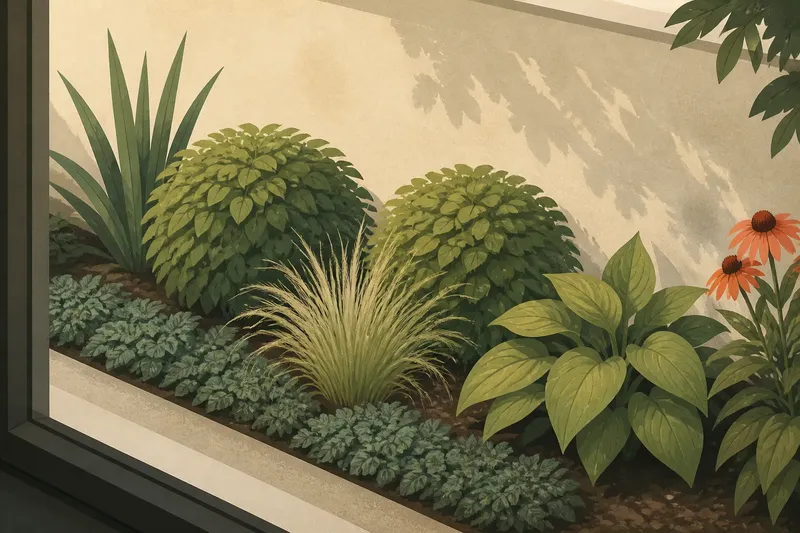
At the kitchen window, a narrow border holds only a handful of plants, yet the eye keeps jumping from one leaf to another. A tall spear-shaped plant stands beside a rounded mound; a fine, airy clump sits near a broad-leaved plant, and a bright flower catches the light at the edge. This is why a border can feel busy even with few plants: the forms compete for attention, not just space.
Consider the border as a small invented situation. Say you have a short strip beside a garden wall, planted with a few different perennials and grasses collected over time. Nothing is crowded enough to touch, but each plant has a distinct outline and several are equally noticeable. The problem is not a shortage of plants or a need for a new color scheme. It is that the eye has no recurring form to settle on.
Count the shapes before changing the planting
In this imagined border, start by looking at the planting from the place where it is usually seen. A simple sketch can help, but a note on a scrap of paper is enough. Record each plant’s main outline: upright, rounded, spreading, arching, or finely textured. The aim is not to identify every botanical detail. It is to notice which forms repeat and which appear just once.
Next, mark the plants that draw the eye first. A plant may stand out because its leaves are unusually large, its stems are strongly vertical, or its flower heads sit above the surrounding foliage. These are visual accents. A border can have several, but if every plant acts as an accent, none has a quiet supporting role.
In the hypothetical strip, the owner sees one upright clump, two separate rounded plants, a spreading groundcover, and a wispy grass. The groundcover and grass both make intricate edges, while each of the other forms occurs in a different place. That variety can be appealing up close, yet from the window it reads as a sequence of unrelated shapes.
Make a quick outline of the border and mark only its largest forms. This reveals whether the eye sees a pattern or a collection.
Let a few repeated forms carry the border
Repetition creates a visual rhythm: the eye recognizes a form, moves through the planting, and recognizes it again. In the imagined border, the owner chooses rounded foliage as the main recurring shape. The two existing mounds remain, and one additional rounded plant is considered for a gap if it suits the site. The fine-textured grass is retained as a contrasting accent, rather than treated as a second repeating theme.
Repeating a form does not mean using only one species or making identical clumps. Several plants can share a broad silhouette while differing in flower, foliage detail, or seasonal interest. The repeated outline provides continuity; smaller distinctions keep the planting from feeling mechanically copied.
It also helps to group the recurring form so it can be read as a deliberate pattern. A rounded plant at each end of a border, with another near the middle, may make a loose rhythm. A single mound isolated between several unrelated silhouettes may instead look accidental. The best arrangement depends on the border’s shape and its viewing angle, so check the outline from the window and from nearby.
Use one form as the recurring note, then let other shapes play supporting parts.
Use height to guide the eye, not interrupt it
Height adds another layer of competition. A tall plant can give a border a focal point, but several plants of different heights placed at irregular intervals may break the planting into disconnected peaks. In the invented strip, the upright clump stands near one end. A second tall accent could balance it, but adding one merely to create symmetry may produce another point of emphasis without improving the overall flow.
Instead, the owner looks at the border as a sequence of low, middle, and tall forms. The rounded plants create a middle-height band. The groundcover gives the front edge a lower line, while the upright clump rises above the rest in one clear location. The grass remains lower than the upright clump and is placed where its movement can soften the transition, rather than compete at the same height.
Think about how silhouettes overlap from the main viewing position. A tall stem that rises behind a broad mound can appear connected to it; the same stem planted alone in a gap may look like a separate exclamation mark. Shifting or replacing a plant can be more useful than adding another one. If a mature plant’s eventual size or site needs are unclear, check its label or the grower’s guidance before deciding where it belongs.
Judge height from the viewing place, because that is where separate plants become one composition.
Keep visual accents distinct?
Can different leaf textures belong in one border?
Yes. Fine, broad, glossy, or deeply divided leaves can add contrast, but several strong textures placed together may make the planting feel restless. In the imagined border, the fine grass is kept as one contrasting accent among the rounded leaves.
Should every plant have a different outline?
No. Distinctive forms can make individual plants memorable, but a border often feels more coherent when some silhouettes recur. Repetition lets the eye connect separate parts without requiring every plant to match.
What if the border is viewed from more than one side?
Look at the planting from each regular viewpoint and note where the tall forms interrupt one another. A repeated outline can still hold the composition together, while the relative placement of accents may need to work from more than one angle.
Does repeating a shape mean repeating the same plant?
Not necessarily. Plants with different flowers or leaf details may share a rounded, upright, or arching outline. Choose them for the actual growing conditions as well as the shape they contribute.
Make one change, then read the result
In the invented situation, the owner does not clear the border and start over. First, a sketch shows the main shapes and heights. Then the owner decides to keep the rounded plants as the recurring form, leave the upright clump as the single tall accent, and move the fine grass slightly closer to the main group. The spreading groundcover remains at the front, where it draws a calmer edge instead of breaking up the middle.
The expected observable result is a more legible sequence: a low edge, repeated rounded forms, and one clear rise above them. The planting still contains contrasts, but fewer shapes demand attention at once. If the change makes the border feel too uniform, the owner can retain one additional accent rather than restoring every original form.
Making changes gradually matters because plants respond to their site and may not be ready to move at the same time. Some can be divided or transplanted during a suitable season; others may be better left in place while neighboring plants are adjusted. A gardener can also use a temporary pot or an empty container to preview the silhouette in a proposed position before committing to a new planting.
After any adjustment, look again from the original viewpoint. If the eye moves smoothly between repeated forms and pauses at the intended accent, the border has gained coherence. It need not be uniform or sparse; it only needs a pattern that makes its variety readable.
When a border still feels busy despite having few plants, trace the shapes and heights before shopping for more. A small number of repeated forms can give the planting a clear visual thread, while one or two contrasting accents preserve its character.