The Garden in the Picture: How Painted Landscapes Shaped Garden Ideas
Learn how painted landscapes can shape garden ideas, helping you arrange depth, frame a view and turn a patch of ground into a composed scene.
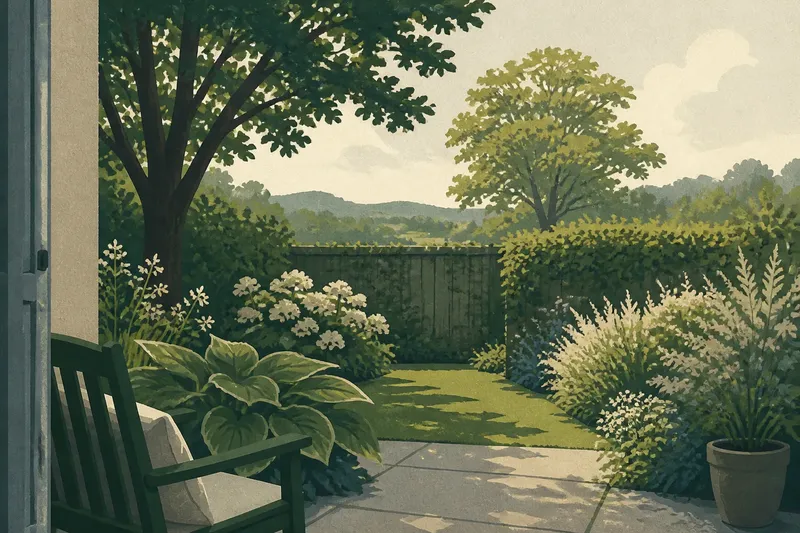
A painted landscape can make a distant tree seem important, a strip of water feel close, or a dark hedge lead the eye toward a bright opening. Those choices offer useful garden ideas: not a blueprint to copy, but a way to see how a scene is composed. Begin with one painting and a real view outside, then translate its visual relationships into a garden you can actually tend.
Choose a painting for its structure, not its plants
Look through a book, visit a gallery, or browse a reliable collection of landscape paintings. Choose an image that holds your attention because of its arrangement. The plants do not need to suit your climate, and the scene need not depict a garden. A meadow, riverbank, rocky coast, or wooded lane can each offer a useful pattern of near and far.
Before studying details, ask what the picture seems to do with space. Does it draw you toward a bright distance? Does a large tree anchor one side? Do bands of land overlap, or does a winding feature connect the foreground to the back? These relationships are the parts that can be adapted to a garden.
Set aside images that appeal only because of a particular flower or color. The aim is to borrow a way of arranging space, not to reproduce a painting’s subject. A landscape can be compelling even when you cannot identify every plant in it.
Read the picture from foreground to distance
Divide the image loosely into three zones: foreground, middle distance, and background. These are not exact measurements. They are useful names for what appears close, what occupies the middle of the scene, and what seems far away.
The foreground often gives the eye a place to begin. It might hold a dark branch, a patch of rough ground, or a low bank. In a garden, this role could belong to a leafy edge near a seat, a low planter, or an existing shrub. Keep the feature modest if the real view beyond it is the main attraction.
The middle distance carries the main subject or a visual pause. A pale flowering shrub, a small tree, or an open patch of lawn can serve this purpose, depending on the space. The background gives the view somewhere to settle: perhaps a fence softened by climbing plants, a mature tree beyond the boundary, or a shaded mass of foliage.
Notice how each zone meets the next. A hard, uninterrupted boundary can flatten a scene, while overlapping forms create a sense of depth. A shrub partly obscuring a farther planting can suggest that the garden continues beyond what is immediately visible.
Try naming one existing feature for each zone before considering additions.
Find a garden view that can carry the composition
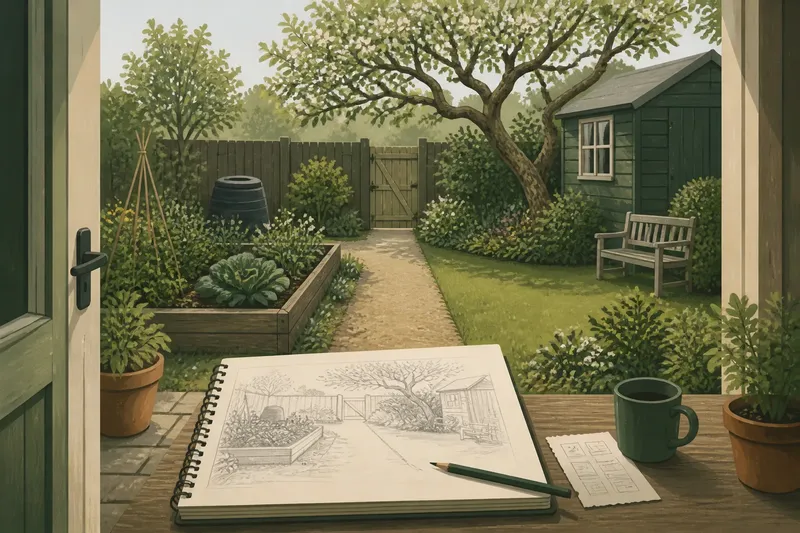
Stand where you are likely to spend time: at a kitchen window, beside a back door, or in a chair you already use. Look outward without moving around to search for the most dramatic angle. A composition that works from an ordinary, repeatable place is more useful than one that can only be seen from an awkward corner.
Notice the edges of the view. A doorframe, a gap between branches, or the sides of a porch can act like the borders of a picture. Outside those edges, identify what is fixed: a fence, a neighboring wall, a large tree, or a change in ground level. These elements already shape the scene, whether or not they were deliberately designed.
Now identify the most prominent point in the view. It might be a tree trunk, a bright flower bed, a birdbath, or a patch of sky. Ask whether it should remain the focus or whether the painting suggests a quieter destination. You are not required to add a focal object; sometimes an open view does the work better.
Say you look from the kitchen at a plain fence, with a mature tree visible over its left end. Imagine adding a small group of broad-leaved plants near the fence and leaving the tree’s outline unobstructed. The nearer leaves could give the view a starting point, while the distant tree remains its destination. This is an invented scenario, not a prescribed plan; the observable result to look for is whether the eye travels from the planting toward the tree rather than stopping at the fence.
Translate depth into garden forms
Once you understand the picture’s spatial structure, decide which garden forms could express it. A tall, broad shape can establish a strong edge. A lower, looser planting can sit in front of it. A clear opening between forms can suggest distance or provide a path for the eye.
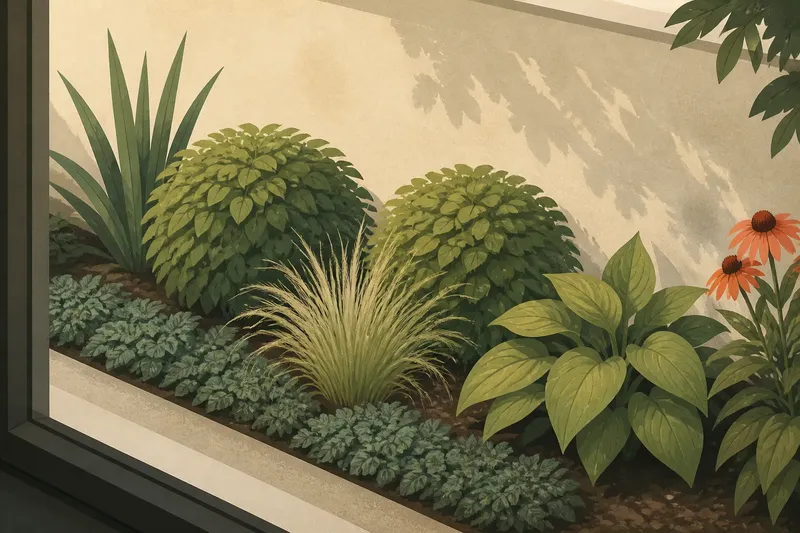
Depth does not depend on installing a succession of objects. It can come from differences in silhouette, density, or light. Dense evergreen foliage behind airy grasses, for example, creates a contrast between a solid plane and a more open one. A single gap in a hedge may reveal a view that otherwise goes unnoticed.
Use the painting to consider relationships rather than plant names. If its foreground is dark and its distance is light, ask whether a similar contrast already exists in your garden. If the scene builds from low forms to a tall one, look for a way to create that progression with plants suited to your conditions. The effect matters more than a literal match.
Consider the mature shape of a plant before placing it. A small specimen may eventually cover a view or press against a path. Check the plant label and the maker’s instructions where relevant, and account for local growing conditions and rules; the appropriate choice depends on those details.
Use edges and openings to guide the eye
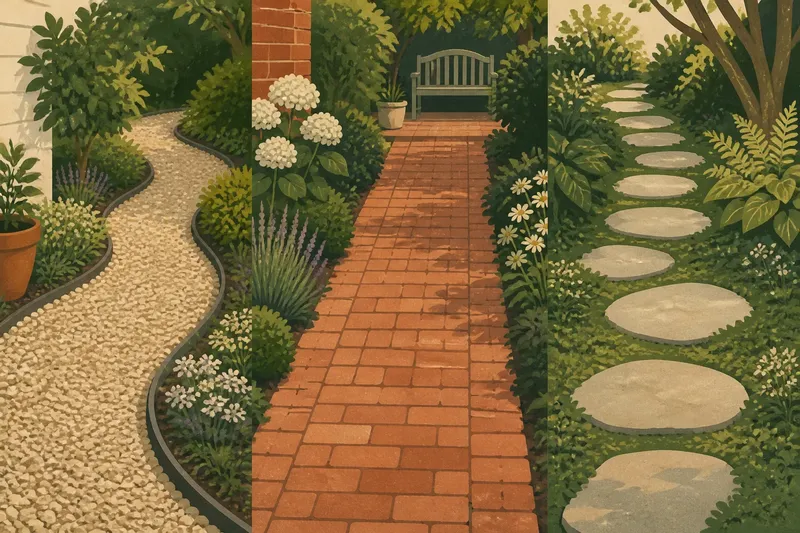
Paintings often use a strong diagonal, a stream, a path, or a line of trees to carry attention into the scene. A garden can use the same visual role without copying the feature itself. A change in paving, a line of low plants, or the edge of a lawn may lead toward a focal point.
Curves and diagonals can make a view feel less static, but they need a reason. A curved bed that wanders without relating to anything else may look arbitrary. Let a line connect two features: for instance, guide the eye from the entrance toward a tree, or from a seat toward a brighter opening in the planting.
Openings are just as useful as lines. A gap in foliage may reveal a distant tree; a low planting may keep a view of the sky available. When deciding whether to close an empty area, consider whether that apparent blankness is giving the composition breathing room.
Stand at your chosen viewpoint after any small adjustment. If the line points somewhere unintended, change its direction or soften it rather than adding more features.
Make a small change and judge it from the same place
Keep the first intervention limited. Move a container, prune a suitable plant according to its care needs, or mark a possible bed edge with a garden hose before committing. A reversible trial makes it easier to see whether the borrowed composition belongs in the actual space.
Observe the view at different times of day. Light can turn a pale wall into a bright destination or leave a once-prominent feature in shade. Check the scene from the same window or seat, and note whether the intended foreground, middle distance, and background remain legible. You are looking for a clear visual relationship, not a perfect imitation.
Also consider what the arrangement asks of you. A plant that needs conditions your garden cannot provide may be a poor translation of the painting’s shape. Find a locally suitable plant with a similar outline or visual weight instead. A garden composition has to live through seasons and routine care, unlike a painted image.
Questions gardeners ask about painted landscapes?
Do I need to copy a famous painting?
No. Any landscape image can help you notice depth, edges, and visual emphasis. Choose one whose arrangement is easy to describe, then adapt those relationships to your own setting.
What if my garden has no distant view?
Use layers within the space itself. A nearby screen of foliage, a middle planting, and an open or lighter area can create a sense of depth without a far horizon.
Can a painting help with a very small garden?
Yes, if you borrow a simple relationship rather than many details. One clear foreground element and one visible destination may be enough to give a compact view a sense of direction.
How do I know whether the composition works?
Look from the viewpoint you chose and see whether the eye moves through the scene in the intended order. If attention keeps snagging on an unrelated object, adjust the view or let that object become part of the composition.
Let the garden become its own picture
A painted landscape can sharpen attention, but the garden should answer to its place. Keep the elements that suit the light, soil, boundaries, and habits of the household; alter or leave aside the rest. The most useful garden ideas often begin with a simple question: what does the view ask the eye to notice next?
Return to your chosen viewpoint after the garden changes with the seasons. A once-hidden branch may frame the sky, or an open patch may become the calm center of the scene. Use those ordinary shifts as fresh information, and let the composition grow from what the garden actually offers.